
Le problème
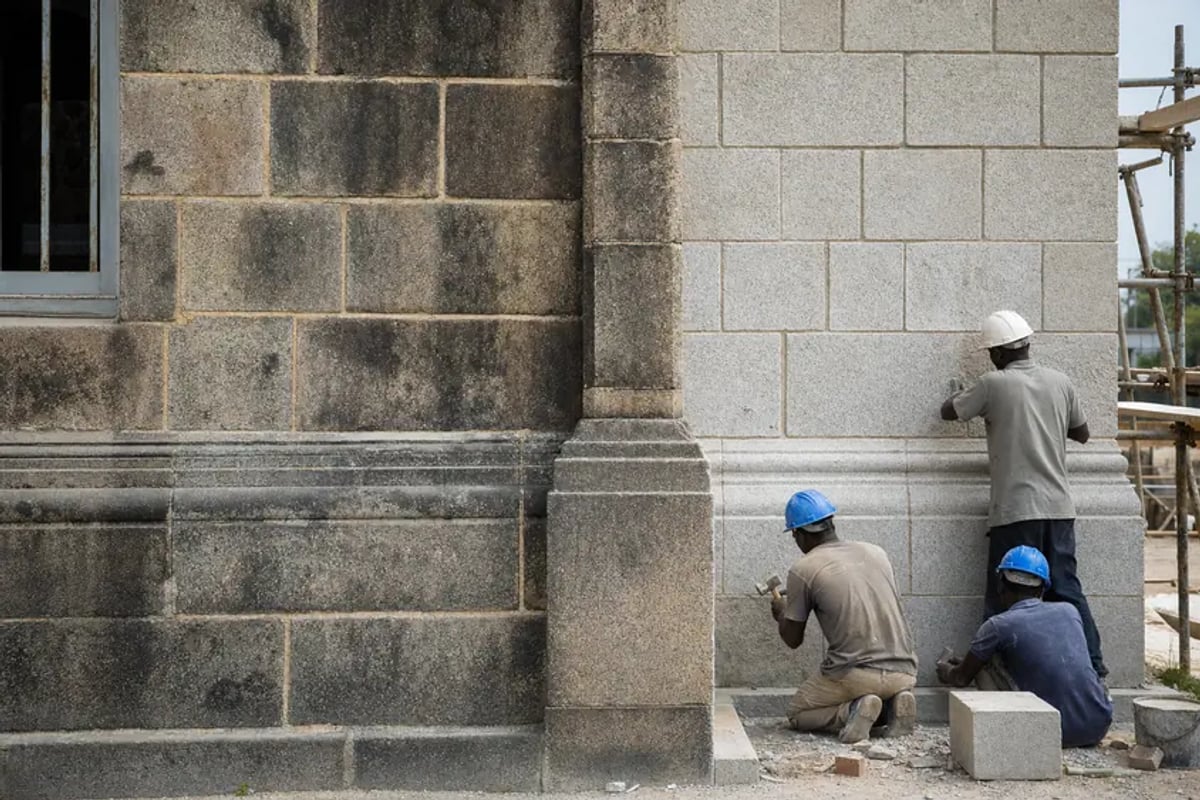
Heritage-stone-restoration commissions require historically appropriate stone sourcing, traditional-tool methodology, and respect for the original installer's specification intent.
Notre approche
Granite Ghana delivers heritage-stone-restoration through provenance-matched stone sourcing, hand-honed traditional methodology, and methodology-documented restoration — the work reads consistent with the original installer's discipline.
Granite Ghana delivers heritage-stone-restoration through provenance-matched stone sourcing, hand-honed traditional methodology, and methodology-documented restoration — the work reads consistent with the original installer's discipline.
The Challenge
Historic residences, heritage government buildings, and legacy diplomatic properties across Ghana carry stone surfaces installed decades — in some cases, generations — before current specification standards existed. When time, humidity, salinity, and heavy institutional use degrade these surfaces, the restoration challenge is rarely one of simple replacement. The original stone may no longer be quarried at its source. The veining pattern, crystalline density, and surface character of surviving slabs form a visual record that a poorly matched replacement will permanently disrupt.
Institutional custodians and heritage property managers face an uncomfortable arithmetic: the cost of doing nothing is accelerating deterioration, while the cost of doing it wrong is irreversible. A mismatched slab in a Colonial-era receiving room, a re-honed surface that reads at a different reflectance level from its neighbours, or a grout colour that contrasts with the original joint treatment — each of these signals that the restoration was not equal to the original installation. For buildings that carry institutional, diplomatic, or heritage designation, that signal carries consequence.
The Granite Ghana Solution
Granite Ghana’s heritage stone restoration methodology begins before a single tool touches the existing surface. Our project office conducts a provenance assessment — documenting the existing stone’s geological type, finish register, joint treatment, and movement pattern — then cross-references against our 52-year materials archive and our active quarry relationships across West Africa, Southern Europe, and the Indian Sub-continent. Where the original stone is still accessible at source, we commission provenance-matched slabs. Where the original quarry is exhausted, we identify the closest geological analogue through physical sampling and comparative honing trials, presenting documented options to the client before specification is confirmed.
Installation follows hand-honed traditional methodology supervised by senior site specialists with multi-decade restoration experience. Every stage — substrate preparation, adhesive selection, slab fitting, joint treatment, surface honing, and final sealing — is methodology-documented and submitted to the client as a restoration record. The completed work reads consistent with the original installer’s discipline. That is the standard we hold.
Material + System Specification
- Provenance-matched stone sourcing — geological profiling and quarry liaison conducted prior to procurement; physical sample approval required before any slab is cut
- Hand-honing and surface calibration — existing surviving slabs are honed to a calibrated finish register; replacement slabs are matched to the same register before installation
- Heritage-compatible adhesive systems — substrate-specific adhesive and underlayment selection, avoiding modern fast-set systems incompatible with historic substrate movement
- Period-appropriate joint treatment — lime-based or mineral grout compounds matched by colour, joint width, and texture to the original installation record
- Sealant systems rated for heritage substrates — breathable, non-film-forming penetrating sealers suited to stone that has been in service for 30 or more years
- Methodology documentation package — written restoration record delivered at project close, including stone provenance, honing specifications, product data sheets, and photographic site record
Typical Project Profile
Heritage stone restoration engagements typically range from 80 to 600 square metres of affected surface, with project timelines of four to fourteen weeks depending on scope, provenance sourcing lead times, and site access constraints. Sectors served include historic government and civic buildings, Colonial-era and post-independence diplomatic residences, premium heritage hospitality properties, and private legacy residences of institutional-grade specification. Projects frequently involve phased works to maintain partial building occupancy during restoration.
Outcomes
- Restored surfaces read visually continuous with surviving original stone — the intervention is not legible to the untrained eye
- Provenance documentation provides the property custodian with a defensible materials record for heritage registration and insurance purposes
- Correct substrate and adhesive specification prevents the accelerated re-deterioration that follows poorly matched modern restoration systems
- Hand-honed finish calibration eliminates the reflectance differential that exposes mismatched replacement work under directional or natural light
- Methodology-documented delivery provides institutional clients with a restoration record that supports future maintenance planning and specification continuity