
The problem
Premium-residential and hospitality operators face multi-property granite maintenance challenges — surface refresh cycles, sealant lifecycle management, restoration-grade re-polish methodology.
Our approach
Granite Ghana operates multi-property granite maintenance programmes — annual inspection, surface refresh, sealant lifecycle management, restoration-grade re-polish methodology under a single contract.
Granite Ghana operates multi-property granite maintenance programmes — annual inspection, surface refresh, sealant lifecycle management, restoration-grade re-polish methodology under a single contract.
The Challenge
Hospitality groups and multi-site corporate operators in Ghana share a common and costly problem: granite and stone surfaces across their portfolio age at different rates, receive inconsistent care, and — without a coordinated programme — accumulate surface damage that eventually requires full replacement rather than restoration. A lobby installed in 2018 begins to show micro-scratching and sealant breakdown by 2022. A spa vanity loses its polish register within eighteen months of commissioning if the correct maintenance chemistry is never applied. Across a portfolio of four to twelve properties, these timelines diverge, and the cumulative cost of reactive repair far exceeds the cost of structured preventive care.
The challenge is compounded by the specification diversity inherent in any estate built across multiple project cycles. Premium granite, Carrara marble, engineered quartz countertops, and heritage stone panels each carry distinct maintenance protocols — different sealant chemistries, different abrasive thresholds, different re-polish frequencies. Without a single materials-knowledgeable custodian across the portfolio, site teams apply generic cleaning regimes that accelerate surface degradation rather than prevent it. The result is premature stone failure on surfaces that were specified, and budgeted, to last generations.
The Granite Ghana Solution
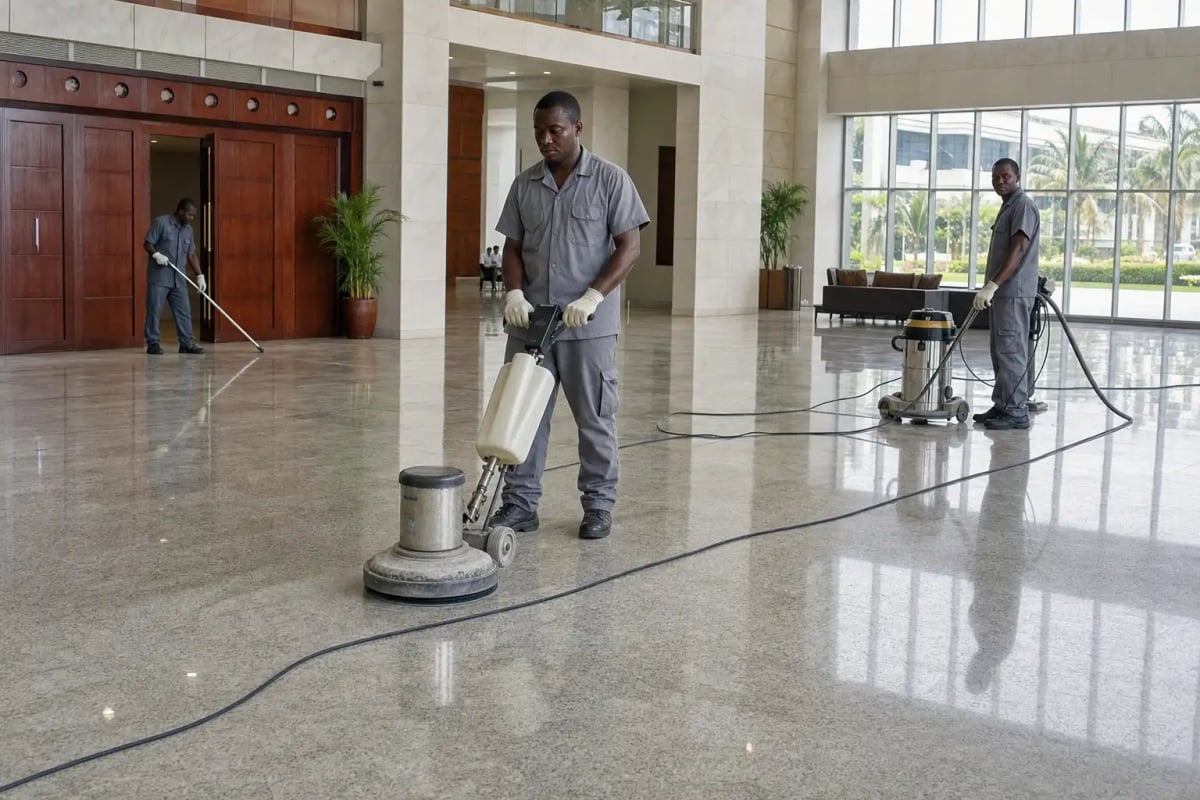
Granite Ghana operates structured multi-property maintenance programmes under a single annual contract — consolidating inspection scheduling, sealant lifecycle management, surface refresh sequencing, and restoration-grade re-polish methodology across all enrolled properties. Established in 1974 and carrying 52 years of institutional stone practice, the programme draws on direct material knowledge: the same specialists who fabricate and install specification-grade granite slabs understand precisely how those surfaces perform under Ghana’s humidity, temperature cycling, and heavy-traffic conditions.
Each enrolled property receives a baseline stone audit — cataloguing surface area, stone type, current condition grade, sealant age, and any existing damage. From this audit, a property-specific maintenance calendar is issued. Surface refresh visits, sealant reapplication cycles, and re-polish interventions are sequenced to minimise operational disruption across hotel lobbies, banking hall concourses, boardroom floors, and spa environments. Where surface damage has progressed, restoration-grade diamond polishing brings the stone back to its specification finish without replacement.
Material + System Specification
- Sealant lifecycle management — penetrating impregnator sealants rated for high-humidity tropical environments, reapplied on property-specific cycles of 12 to 36 months depending on stone porosity and traffic classification
- Diamond re-polish methodology — graduated diamond pad sequencing from 50-grit restoration to 3,000-grit specification polish, matched to original surface finish
- Surface condition grading — a proprietary four-point condition scale assessed at each visit, with written reports issued to the property facilities manager
- Stone-matched chemistry — cleaning and maintenance products specified per stone type: granite, marble, and engineered quartz each receive chemically appropriate treatment regimes
- Emergency response protocol — priority site mobilisation for spill incidents, impact damage, or acute surface failure across all enrolled properties
- Centralised reporting — annual summary report consolidating condition grades, interventions completed, and forward maintenance recommendations across the full portfolio
Typical Project Profile
A typical multi-property programme enrols between three and twelve properties — spanning premium hotel lobbies and guest-floor vanities, Tier-1 bank headquarters concourses, diplomatic residences, and corporate reception environments — under a twelve-month rolling contract with a quarterly review cycle. Individual properties range from 200 to 2,400 square metres of enrolled stone surface. The programme is designed for operators who commission specification-grade stone and require that investment to perform at its original register for decades, not years.
Outcomes
- Stone surfaces maintained to original specification finish across multi-site portfolios, eliminating the patchwork degradation that characterises uncoordinated reactive care
- Sealant failure rates reduced through scheduled reapplication before porosity breach, extending stone service life significantly beyond unmanaged timelines
- Restoration-grade re-polish returning aged surfaces to commission standard without slab replacement — preserving capital expenditure already committed
- Single-contract accountability replacing multiple ad hoc vendor relationships across the portfolio, with consolidated documentation for facilities and asset management teams
- Measurable extension of stone asset life, supporting the fundamental specification principle that stone that outlasts the building requires stone that is properly maintained