
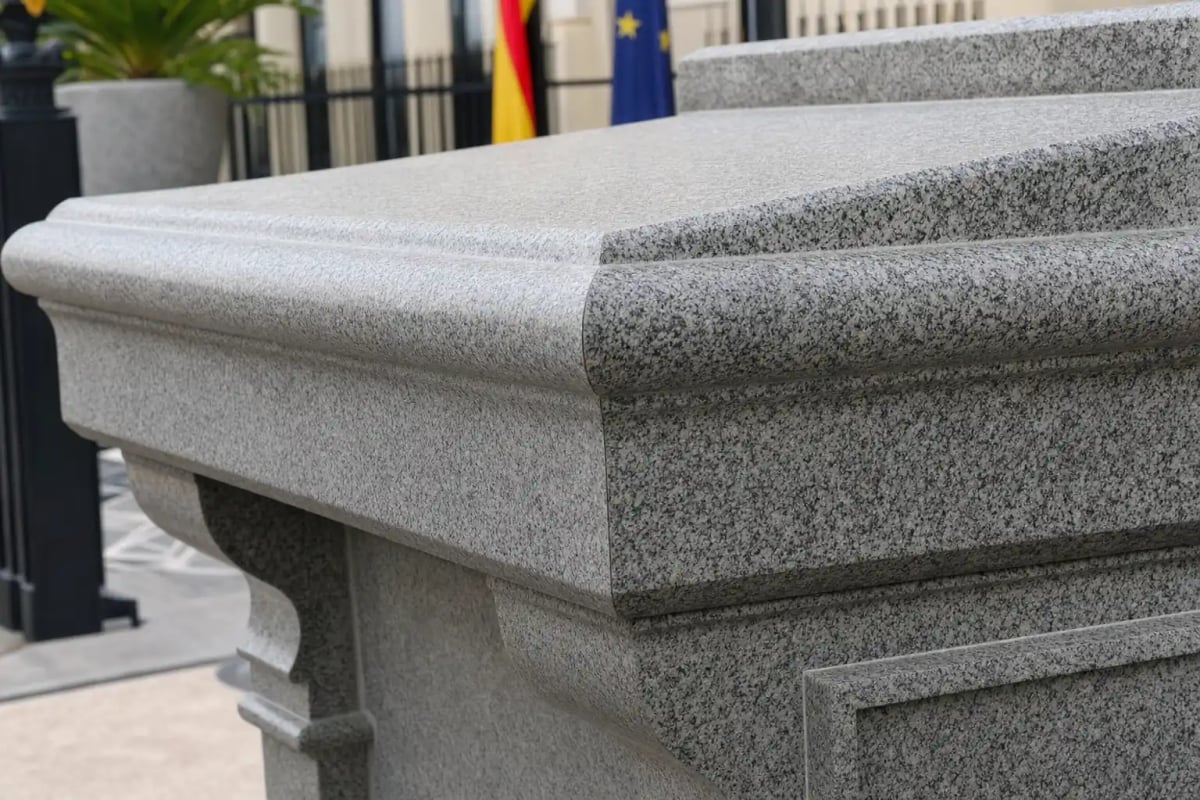
The problem
Embassy custom-stonework commissions require ceremonial-grade material handling, full traceability documentation, and discipline in handling diplomatic-protocol installation windows.
Our approach
Granite Ghana delivers embassy custom-stonework with bespoke fabrication, ceremonial-installation discipline, and documentation chain — the work meets diplomatic-protocol requirements without compromise.
Granite Ghana delivers embassy custom-stonework with bespoke fabrication, ceremonial-installation discipline, and documentation chain — the work meets diplomatic-protocol requirements without compromise.
The Challenge
Diplomatic premises operate under conditions that admit no ambiguity. When a mission commissions bespoke stonework — a ceremonial mantelpiece, a reception hall feature wall, a credenza surround in the High Commissioner’s anteroom — the specification carries weight far beyond aesthetics. Material traceability, fabrication precision, and installation sequence must each be documented to a standard that satisfies both the client’s interior architect and the mission’s security and protocol officers. Most stone fabricators in Ghana are equipped for commercial fitouts. Very few carry the documentation discipline, the ceremonial-installation methodology, and the slab-selection rigour that diplomatic work demands.
The consequences of falling short are not merely aesthetic. A poorly sequenced installation disrupts mission operations. A mismatch in vein pattern across a book-matched panel reflects on the commissioning authority. Stone that was not properly acclimatised before installation will move, crack, or open hairline joints within two seasonal cycles — visible failure in a space designed to project permanence. The diplomatic sector requires a stone partner who understands that the finished installation is a statement of institutional character, not simply a surface.
The Granite Ghana Solution
Granite Ghana has delivered bespoke stonework for diplomatic and embassy-class interiors since the practice’s establishment in 1974. The project office assigns a dedicated specification lead to each diplomatic commission — a specialist whose entire scope covers material sourcing, slab selection, fabrication supervision, and installation sign-off. Nothing moves to site without documented approval at each gate. Book-matched panels are sequenced in the fabrication workshop before transport, photographed, and presented to the client’s representative for confirmation prior to any cutting.
Fabrication is executed at the Tema project workshop, where CNC water-jet cutting and hand-finishing are both available. For ceremonial elements — mantelpieces, carved relief surrounds, monolithic reception counters — hand-finishing by the studio’s stone-finishing specialists ensures that no two commissions are identical. Edge profiles, surface textures, and jointing tolerances are specified in writing against the design drawings and held without deviation through the installation sequence. The project closes with a material certificate, an installation-as-built record, and a five-year workmanship statement — documentation the mission can retain as part of its premises record.
Material + System Specification
- Slab stock: Specification-grade granite and marble sourced with full provenance documentation; slab batches reserved per commission to ensure tonal and veining consistency across all elements
- Book-matching: Sequential slab pairs selected and sequenced in-workshop before fabrication begins; photographic record provided to client before cutting commences
- Fabrication tolerance: CNC water-jet cutting to ±0.5 mm on panel dimensions; hand-finishing applied to ceremonial elements, carved profiles, and custom edge details
- Substrate preparation: Full structural assessment of receiving wall or base prior to installation; specialist-grade adhesive and mechanical fixing systems selected per substrate type
- Installation sequencing: Phased installation calendar agreed with mission facilities officer to avoid disruption to operational areas; each phase signed off before the next commences
- Closeout documentation: Material certificate, slab provenance record, installation-as-built drawings, and five-year workmanship statement issued at practical completion
Typical Project Profile
A typical diplomatic commission engages Granite Ghana at design-development stage, allowing the specification lead to advise on slab selection, panel sizing, and edge treatment before the architect finalises drawings. Fabrication runs four to eight weeks depending on scope and carving complexity. Installation is typically executed in two to three phased mobilisations across ten to twenty working days. Commissions have included ceremonial reception mantelpieces, feature wall cladding in mission lobbies, High Commissioner’s office stonework, and bespoke monolithic counters for formal meeting suites — all delivered under the quarry-to-installation discipline Granite Ghana has held for 52 years.
Outcomes
- Ceremonial stonework fabricated and installed to diplomatic-protocol documentation standards, with full traceability from slab to sign-off
- Book-matched panels and carved elements that sustain visual coherence across the life of the premises — stone that outlasts the building
- Zero-disruption phased installation sequenced around the mission’s operational calendar
- A complete closeout dossier — material certificates, as-built records, workmanship statement — retained as part of the premises archive
- An installation that projects institutional permanence: the register appropriate to a diplomatic address