
The problem
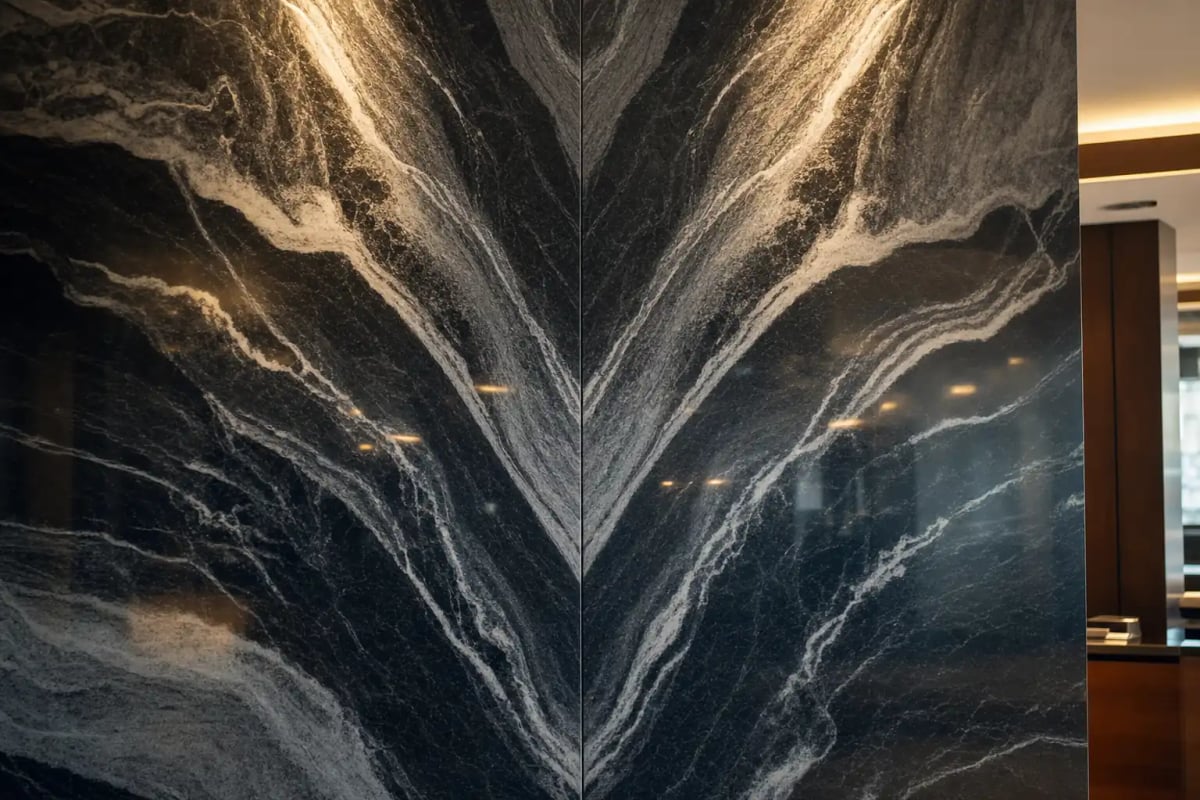
Bookmatched-slab cladding requires careful slab selection from the same block, edge profile coordination, and substrate verification — most fabricators cannot execute the vein-continuity discipline that bookmatching demands.
Our approach
Granite Ghana selects bookmatch-grade slabs from the same block, coordinates edge profiles to maintain vein continuity, and installs to specification-grade substrate verification — the bookmatch reads as a single piece of stone across the wall.
Granite Ghana selects bookmatch-grade slabs from the same block, coordinates edge profiles to maintain vein continuity, and installs to specification-grade substrate verification — the bookmatch reads as a single piece of stone across the wall.
The Challenge
In institutional interiors — bank reception halls, diplomatic lobbies, premium hotel arrivals — a cladded stone wall carries the entire architectural statement of the space. The moment that wall reads as a collection of individual panels rather than a unified field of stone, the statement collapses. Vein discontinuity, misaligned pattern breaks, inconsistent edge reveals: these are the failures that define an installation as specification-inadequate, regardless of the stone’s intrinsic quality.
The technical demand of bookmatch cladding is unforgiving. Slab pairs must originate from the same block, cut in sequence, and maintained in that sequence from quarry through fabrication through installation. Any disruption to the chain — a substituted slab, a misread orientation, a substrate variance that forces a panel shift — destroys the mirror symmetry that makes bookmatching architecturally legible. Ghana’s institutional procurement environment, where project timelines compress and site conditions vary, makes this chain discipline a genuine test of a fabricator’s operational rigour.
The specification stakes are highest in the sectors that matter most: Tier-1 bank headquarters reception counters, diplomatic residence feature walls, corporate boardroom cladding commissioned to signal permanence to every client and counterpart who enters the room. These are the environments where the stone is not decoration — it is the institution’s character expressed in material form.
The Granite Ghana Solution
Granite Ghana approaches bookmatch cladding as a sequenced engineering exercise, not an aesthetic one. Slab selection begins at source: paired slabs are identified from the same quarry block, catalogued by sequence number, and held together through the fabrication pipeline. Vein mapping is conducted before any cutting decision is made, ensuring the mirror axis is positioned for maximum visual coherence at the intended installation height and viewing distance.
Fabrication follows a specification document prepared for each project — edge profile, nominal thickness, substrate interface detail, and setting-out dimensions coordinated with the structural engineer’s drawings. Where wall curvature or dimensional irregularity requires panel modification, adjustments are calculated to preserve the vein axis rather than simply fitting the geometry. The result is an installation that reads as a single continuous piece of stone across the full wall plane.
On site, substrate verification precedes every panel installation. Flatness tolerance, adhesion suitability, and moisture condition are checked to the specification threshold before any slab is committed. Granite Ghana’s installation teams work under a project office structure — not a subcontracted labour arrangement — so the specification integrity established at the fabrication stage is maintained through to final sealing and handover.
Material + System Specification
- Stone grades: Bookmatch-eligible granite and marble sourced from verified quarry blocks; slab pairs catalogued by sequence and block reference
- Nominal panel thickness: 20 mm and 30 mm standard; 18 mm engineered-back options available for high-load structural conditions
- Edge profiles: Eased, bevelled, mitred, and waterfall profiles fabricated to drawing; edge finish matched to panel face finish (polished, honed, or leather)
- Setting system: Specification-grade adhesive mortar system with mechanical anchor backup for panels above 1,200 mm height or in high-humidity zones
- Substrate standard: Flatness tolerance verified to 3 mm in 3 m prior to installation; moisture readings documented and signed off
- Sealing: Penetrating impregnator applied at installation; maintenance specification document provided at project handover
Typical Project Profile
Bookmatch slab cladding commissions typically involve 40 to 400 square metres of cladded wall surface across one or more feature planes. Projects span bank reception and teller hall feature walls, corporate boardroom and reception desk cladding, hotel lobby arrivals columns and feature walls, diplomatic residence principal reception rooms, and high-end retail flagship environments. Programme from slab confirmation to installation completion typically runs eight to fourteen weeks depending on stone origin, panel volume, and site readiness — with the project office providing milestone scheduling from fabrication draw-down through to handover sign-off.
Outcomes
- Feature walls read as a single continuous field of stone — vein continuity preserved across the full installation plane
- Specification-grade substrate verification eliminates post-installation movement, hollow spots, and edge-lift failures
- Panel-level sequence documentation provides a traceable record for future maintenance and matched replacement
- Edge profile consistency and face finish uniformity maintained across all panels to a single fabrication standard
- Stone that outlasts the building — installed to the permanence specification that institutional and diplomatic clients require